Showing posts with label Herbal Infusions. Show all posts

Monday, February 15, 2016

Tumeric Herbal Tea


I recently sludged through a cold and decided to try some tumeric herbal tea. It's been making the rounds on the internet.  I read through several recipes and then made up my own variation.  The taste is pleasant, with a hint of bitterness beneath it. I appreciate bitter flavors. In fact, I think they're important, so this is fine with me.  However, it may not be for everyone.  

As for the efficacy of the concoction, I cannot say.  My cold was short lived and perhaps this herbal brew helped by reducing inflammation. I would try it again.

Ingredients:
  • 2 cups water
  • 1 cup non-dairy milk (I used coconut); for medicinal purposes, I recommend avoiding dairy which encourages phlegm
  • 1 tsp cinnamon and ginger (you could use fresh ginger)
  • Pinch of cloves and nutmeg
  • 1 tsp of ground tumeric; taste and add more if you can manage it
  • Honey, sweeten to taste (I used 1 tsp plus a bit more)
Simmer the water with the spices for about 10 minutes.  If using fresh ginger, strain out the pieces. Add the milk and honey and bring to the bubble stage.  Taste and adjust.  Enjoy!

Note that the mixture can be rather thick.  I found that I could enjoy it best if I kept stirring it, so that the particles didn't settle in the bottom.

Have you made tumeric tea? What's your secret? Any advice for using fresh tumeric?


Monday, October 13, 2014

Tea Alchemy: Butterfly Pea Herbal Infusion


A friend generously shared with me this butterfly pea tea,  a treasure she brought back from Thailand. It's a fun tisane with a bit of fascination.  I thought it would be good for this month of magic!  

To start, the tea brews up in this lovely cobalt blue color.  The taste is, well, a bit legumey but not unpleasant.  Just an unusual flavor for my Westernized taste buds.    


Presto/Chango....When you add a little citrus (in my case, lemon juice), magic ensues!  The herbal tea transforms from the cobalt blue to this lovely aubergine color.  I also preferred the flavor of the brew with a splash of lemon. 


Butterfly Pea herbal tea is known botanically as Clitoria ternatea.  It has been used for Ayurevedic medicine for a very long time and is also used in Southeast Asian cooking as a food coloring.

Have you ever seen this magic herb brewed into tea?

Saturday, February 15, 2014

February is For...

Plum Blossom Herbal Tea

Plum Blossoms!  In Japanese culture, February denotes the time for the delicate and long awaited plum blossom.  The plum is an early blooming tree that blossoms despite the cold weather.  It is one of the three friends of winter, with bamboo and pine.  I haven't seen any plums blooming around here yet, but it may be blooming in the protected shelter of the Japanese or Chinese gardens.  The DH (dear hubby) brought in these plum branches so that they would bloom in February for me (Awww!)


Dried plum blossoms make a delicious tisane, with a pleasing aroma and subtle tart flavor.  The buds hold up to numerous steeps and are said to be good for general relaxation.  My plum blossom herbal tea came from New Century Tea Gallery in Seattle.


Both plum and cherry blossoms are common in Japanese arts and crafts.  A rule of thumb for telling them apart is that cherry blossoms have a little notch in the end of the flower petal while plum blossoms do not.  I believe the motif in the teapot below is plum (no notch).  If anyone thinks differently, please tell me.


Monday, November 18, 2013

Herbal Teas for the Evening


Ginger-Thyme Tea

Hello, blog readers - As the nights grow longer, darker and cooler, I find myself wanting a warm beverage to sip in the evening.  And more often than not, I want that beverage to be without caffeine.  I'm fortunate that we grow many herbs in our garden and I'm often able to make a fresh herbal tisane, like above.  I also enjoy dried herbal/flower teas.  I recently picked up some dried plum blossom and a friend gave me some linden flower tisane (more on these later!)  What are YOUR favorite herbal brews?  Does anyone dry your own herbs?  Any tips there?

Recently, I was approached by the Buddha Herbs company to review some of their blends.  Given my interest in herbals these days, I agreed.  I was expecting a handful of herbal tea bags, so imagine my surprise when I received a giant box in the mail with several boxes of herbal teas as well as supplements!  I have been enjoying the herbal blends, particularly the raspberry leaf. The DH has been drinking the chamomile.  (I don't drink chamomile because of allergies - it's in the ragweed family.) I am also sharing the generous bounty with a local community group that regularly has meetings over coffee/tea, and they send thanks as well!

Friday, October 25, 2013

What is Yerba Mate and How Do I Make and Drink It?

A formal mate gourd and the loose leaf brand my friend prefers

I am very happy to co-author this blog post with my good friend, AM.  I recently had the wonderful opportunity to learn about and drink yerba mate with her family and some other tea friends.  Yerba mate is the plant from which the beverage "mate" is made.  While this is indeed an herbal (it's not from the camellia sinensis tea plant), it's a bit of an anomaly in the herbal world.  It contains caffeine - or to be technical, a chemical compound that some believe is caffeine and others believe is close but not the same.  Either way, it contains a stimulant and should be sipped with that in mind.  I find the beverage to be savory and filling.  It's flavor is a complex blend (to me, anyway) of vegetal, herbal and a tiny pinch of mint.

I am happy to share the rest of this blog post with you, written by AM who is from Argentina, one of the South American countries where yerba mate is part of many people's life.  Enjoy!

Mate is an infusion made with yerba mate and drunk all over southern South America (Argentina, Uruguay, Paraguay and southern Brazil mainly). Yerba mate is a large bush with bright green leaves that grows in warm, humid climates. You may have seen it here in the US in the form of tea bags or as iced tea. In Argentina, the traditional way is to drink it communally out of a hollowed out and dried gourd, with a metal straw.
A less formal gourd, beautiful in its simplicity

The way it works is this: the host or the person who decides to make mate (in my parents' house, it's almost always my dad) fills the mate (the hollowed out gourd is called the mate) with yerba mate (about 2/3 to 3/4 of the way up usually) and then, before pouring the hot water in the mate for the first time, you need to add a splash of cold water (a teaspoon or so), to settle the leaves and prevent them from burning. Then you fill the gourd with hot water on the verge of boiling. The host drinks the mate with the straw until there's no liquid left. This is done rapidly, usually within a minute or two. The host pours water in the mate again and sometimes drinks the second one as well. The reason for this is that the first pour (and even the second) tends to be very strong. The host pours the next mate and hands it to a guest, who drinks it rapidly (within three minutes usually) and returns it to the host. The host refills the mate and hands it to the next guest. The order is determined depending on where people are sitting. (It proceeds in order, in any direction, from the place where the host sits. Mate can move clockwise or counterclockwise. The host decides). The mate then moves around the table until it's the host's turn to drink again. The host is the only person to pour water into the mate.

The mate drinking circle continues until people don't want to drink anymore. At any time, you can say "thank you" and drop out of the mate drinking. The host continues serving until people no longer want to drink. If the infusion gets too weak, the host may decide to change the yerba mate and start anew with fresh yerba mate.

Don't move the straw!  That stirs up the leaf and you want it to stick in place

Yerba mate is green and is a mix of dry, often powdered, leaves and twigs. The flavor is intense, herbal and somewhat bitter. For most people, it's an acquired taste. Like tea and coffee, it has a stimulant effect.

The usual times to drink mate is in the morning, with breakfast, or as an afternoon break with pastries or cookies to go along with it. Some people drink it in parks, beaches and during road trips. In Argentina, you can easily get hot water for your mate-making needs in gas stations. 

Have you enjoyed mate?  How about in the traditional way?

Saturday, February 16, 2013

Rosemary Herbal Tea


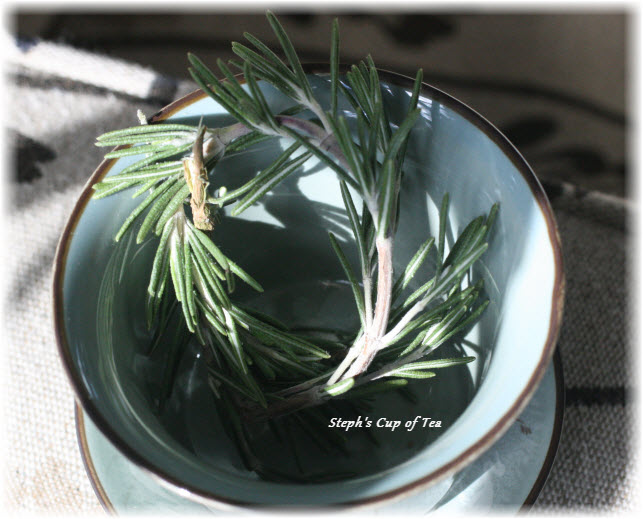
Steeping a rosemary wreath

We've had the sniffles at my house, and the DH and I have been sipping mugs of rosemary (above) and thyme herbal infusions.

I'm fond of rosemary.  I love its aroma and flavor.  It's featured in my favorite cucumber sandwich recipe.  It's the herb of remembrance.  (Friend Nancy and her sister have a tearoom, herb store and blog related to this tradition.) 

Where I live, it grows year-round and I feel fortunate to be able to snip a few branches even in the winter!  It 's not fussy.  Here, I just rinsed the leaves, coiled them and poured boiling water over to steep for 10 minutes.  In later spring, the bush provides another gift:  pretty pale blue blooms.

There are many uses for the herbal infusion.  It has antioxidants as well as other compounds that are anti-inflammatory, anti-allergic, anti-fungal and anti-septic.  It's also a good source of folic acid, vitamins A, and C and iron.  There are probably many other benefits.

Have you ever tried a rosemary infusion?  I've found it to have a very pleasing aroma and flavor.  


Tuesday, December 11, 2012

Gifts for Herbal Tea Lovers

Many of you have enjoyed my series on herbal infusions (mostly from the garden).  I thought I'd wrap up the year by pointing to a couple of vendor sources.

Bird's Eye Tea recently sent me a box of samples to review.  I'm always eager to support a small business, and this one is in my neck of the woods.  One of my favorite things about these samples was the hand labeling.  In the picture above and below, I'm drinking the Honeybush Spice.  It's a delicious and sweet cup, though no sweetener is added.  The sweetness comes from the honeybush itself, and balances well with the other warming spices.  I've also tasted the Xocotal which is unlike any hot chocolate I've ever had!  It's made of raw cacao, rose petals, chamomile, spearmint, ginger, cinnamon, star anise, chipotle powder and roasted cacao nibs.  Per the instructions, I steeped it, added some warm milk and then a bit of sweetener.  (I used just a touch of agave.)  It was really good!  Bird's Eye Tea offers these two herbal blends along with others as a tea-of-the-month arrangement.  See the website for more details.  I'm sending best wishes to this small, woman-run business.

Two Leaves Tea Company also recently sent me a sachet sampler pack.  It came with 18 tea sachets, samples from the entire line.  About half of these sachets are herbal teas, and I've been enjoying them in the evening.  This would make a nice gift for someone who appreciates herbal teas or is beginning to expand his/her knowledge of of  teas.  It's priced right at $14.95


Got any perfect herbal tea gifts to recommend?

Wednesday, October 31, 2012

Rose Hip Tea

Fall brings rose hips in my neighborhood.  I love these plump orange/red fruits.  Picked when ripe but juicy (left), these can be made into a fresh herbal tea.  Picked when dried (right), or allowed to dry naturally, they can be stored for a teatime beverage in the wintertime.  (The hips are high in Vitamin C.)

This was my first experience making fresh rose hip tea, and I'm not sure I've got it right just yet.  Everything I read suggested that I needed to open the hip and remove the fuzzy seeds inside.  I did this, more or less.  What is your advice, is this necessary?
Also, I think I needed about double the amount of fruit, for a stronger brew.  My herbal tea was delicious, but lightly flavored.  With more fruit, it would brew faster and stronger. 

The liquid itself was full of small filaments.  I'm not sure if it was pulp or the fur from the few remaining seeds.  Thoughts?  A simple solution to this was to pour the liquid through a tea sock (cloth filter, but paper would work, too).
The flavor was delicately tart with a hint of sweetness and rosiness.  I enjoyed and will definitely keep experimenting with the formula.  I'd love to hear your advice!

Tuesday, July 17, 2012

Drinking Vinegars

It's such a Portland thing...chef of famed Pok Pok restaurant was wandering through the aisles in an Asian market and noticed the "drinking vinegar" on the shelves.  He tried it, liked it, and decided to bring it to his restaurant.  And now it's all the rage (at least out here).  

But drinking vinegars have actually been around for some time.  They're quite popular in Asia.  And they've part of an old-timey drink called a shrub. 

Blossom Vinegars is a local business making vinegars of all sorts, including the drinking variety.  The owner sells at my local farmer's market.  The DH and I brought home a bottle of the Wildflower Honey Cherry drinking vinegar.  When 2 Tbsp are mixed with 6-8 ounces of sparkling water, it makes a refreshing drink!  It's a nice balance of tart and sweet, and very refreshing.

Have you heard of drinking vinegars?  Tried them?

Thursday, July 05, 2012

Considering Chamomile

Chamomile tea fans - please come to the rescue!  I confess, I am not a fan.  First, chamomile is of the ragweed family and I avoid it due to allergies.  Second, the plant (in my opinion) is stinky.  Plucking it out of the fields where it grows wild, the aroma overwhelms me. 

To its credit, the little flowers are pretty and hardy!  I like them as a bouquet. 

The DH sampled the herbal tea for me. He described it as NOT vegetal, lightly sweet with a hint of licorice.
For those chamomile fans out there, help me out!  What do you love about this herbal tea?

Thursday, June 21, 2012

Funny Fennel


Isn't fennel a funny little plant?  Shown above are two types that made it into the pot tonight.  The back spindly one is bronze fennel.  The front lighter green one is the kind of fennel that produces the white, edible bulbs sold in grocery stores.  Both are very nice to munch on while in the garden.

To brew, I took my kitchen shears and chopped up the fennel coarsely, then shoved it into the pot.  I added boiling water and steeped for 10 minutes. The liquor morphed into a gorgeous shade of celadon!  The light was softening and I couldn't get a good photo, so you'll have to trust me. 

The aroma of the first 10-minute brew surprised me.  It was vegetal/roasty, like some green teas.  I was even more surprised to find the taste to be very sweet.  The "licorice flavor" was not at all overpowering.  An interesting combination!  (I like it.)
Brewing for 20 minutes produced a (slightly) sweeter cup, and the vegetal/roasty aroma remained.  In my herb book, fennel is noted for being a good stomach and intestinal remedy. 

Do you like fennel?  Do you drink it as an herbal tea?

Saturday, June 16, 2012

Iced Pineapple Mint

Iced Pineapple Mint
*Read about the book below

Pineapple mint is such a pretty and aromatic plant that yields a spectacular iced tisane.  Thanks to Alex for the recommendation!
This variegated version of apple mint is aggressive/invasive, so if you plant it, keep it well-contained.  (I am benefiting from a garden neighbor's overrun.)  Preparation couldn't be easier:  I simply snipped the plant, rinsed it, rubbed the leaves a bit, shoved them into a teapot (stalks and all),  and steeped with boiling water for 20 minutes.  I let it cool in the fridge and enjoyed this incredibly refreshing drink. 

How to describe its flavor? First, it's not pineapple-flavored.  Not sure how it got that name.  It is less intense on the menthol than other mints, which makes it nice for those of you who find peppermint or spearmint too strong.  The hot tisane is nice, but I agree with Alex.  This one really shines when cold.  I'm at a loss to think of something more refeshing.  I'll be enjoying many glasses this summer.

The herbal tea becomes an attractive yellow-green.  I love how the evening sun is captured in the "rays" on this pressed glass pitcher.  The pitcher belonged to my grandmother.

* About the book:  The glass at the top is sitting on the book Wildwood, a NY Times bestseller.  I read this rather thick volume in 3 days.  It's fun because the setting is Forest Park, in Portland.  (Wildwood Trail is the park's most famous hiking path.)  It even mentions Pittock Mansion.  Go here to watch a video with the author, Colin Meloy and the illustrator (also his wife), Carson Ellis.  Meloy also belongs to the band The Decemberists.  


Friday, June 15, 2012

Iced Herbals - Your Suggestions

Now that summer is starting to think of joining us here in the Pacific Northwest, I've been desiring iced tea/tisanes.  I am enjoying my experiment with brewing fresh herbs, and am trying a few in iced form. Mint is excellent of course.  Today I'm going to try an iced rosemary.    

Though it's not fresh, I wanted to share the pretty colors and textures of this Lavender Lace tea from Zabar's (a fancy deli in New York). It contains lemon verbena, spearmint, cinnamon, lavender and rosemary.  I like it, and the cinnamon adds a nice depth of flavor.  I'll try that trick!

I'd also love YOUR suggestions!  What herbal teas do you enjoy drinking iced, either made with fresh herb or dried?  A winner will be randomly selected from the commenters.  The prize: a sample of the Lavender Lace herbal tea and a surprise.

Saturday, June 02, 2012

Prickly Borage

Borage in the garden

Prickly but pretty, borage is one of our garden favorites both for its lovely color and also for its attrictiveness to the bees.  We've had borage for a number of years, but only this year did I try experimenting by eating its leaves and making an herbal brew.

The tender, baby leaf is edible and used in salads.  It has a light cucumber flavor.  As the plant grows, it gets prickly hairs on the leaves.  These agitate my skin, so I handle the plant with rubber gloves.

Borage is native to Mediterranean countries and had a reputation for brightening spirits.  It has also been thought to reduce fever.  In modern uses, its seeds are used to make gamma-linolenic acid.

Notice the two differently colored flowers

When making an herbal infusion, I use both the leaf and flowers.  I tear up the leaves to encourage the release of the plant's essence.  I poured boiling water over the leaf and steeped for 10 minutes.  The liquor is very light and light tasting, enjoyable and refreshing with the benefit of being caffeine-free.  When I sip the infusion alone, I can get a hint of the cucumber flavor, but that's easily overrun when taken with food.


Have you ever used borage?


Thursday, May 24, 2012

Thyme for Tea (and Lemonade)


Fresh Thyme

Just in time for Memorial Day...let's talk about thyme tea and lemonade!  I'm learning to love this herb.  Its small purple flowers attract bees and make pretty, edible garnish.  We like to throw sprigs of it into salads.  I think I'll try adding it to my bath water.  The herb itself has many other uses, including an herbal tisane. 
The flavor of this infusion is slightly bitter and medicinal, but in a GOOD way. I like its bite.  Part of thyme's chemical makeup includes thymol, an antiseptic and an ingredient in mouthwash.  I'm planning to drink up this tisane the next time I have a cold.  (It's a year-round hearty herb in the Pacific Northwest.)

I wanted to experiment with adding thyme "tea" to lemonade.  Wowzer, we like it! Thyme provides a subtle, but definite, foundation.  It reminds me of margaritas, without the alcohol but with the bite.  Definitely making this again!

Thyme Lemonade
2 cups of strong thyme "tea" (I steeped mine for 45 minutes)
1 cup of water
1 cup of lemon juice
1/2 cup (or less) honey or sugar

How do you use this pretty herb?

Tuesday, May 22, 2012

Herbal "Tea" Series - Red Clover

Red Clover

 I'm going to be blogging throughout the summer on fresh herbal "teas" - aka herbal infusions and tisanes.  (It's not really tea without camellia sinensis.)  This will be fun!  I'm learning tons about what's brewable right outside in the front grass, along the ditch, from the tree or in the garden.

I'm starting with Red Clover because we have fields and fields of it in bloom right now. It's used to replenish nitrogen in the soil.  

To brew it, I used two clean (and pesticide-free) large red clover blossoms.  I added boiling water and steeped for 10 minutes.  The aroma - well, it's like clover!  The taste is lightly sweet and fresh and springy.  See the link above for info on ways that Red Clover is believed to benefit your body.

My next herb will be "Thyme for Tea".   


Saturday, November 05, 2011

Huang Shan Chrysanthemum Fields


Chrysanthemum Field in Huang Shan China

While driving through the Huang Shan, China area we saw fields of white flowers being harvested.  These are the chrysanthemum fields, the flower picked for an herbal tea.  Chrysanthemum tea is slightly sweet and the pretty blossoms make for a lovely and aromatic cup.  I had chrysanthemum tea today at the Chinese Garden, a fitting place to reflect upon my travels.

Chrysanthemum Tea with Goji Berries

Through the end of the month, the Chinese Garden and Portland Chrysanthemum Society are hosting a display of prize-winning blossoms.  They are lovely, which you can see for yourself below.  I learned that along with the plum, orchid and bamboo, chrysanthemum is one of the "Four Honorable Plants" of China.


Chrysanthemum is also known as "Autumn Flower."


"In most ancient essays and poems, writers use the terms "jade bone, icy body, pearl petal and red heart" to describe the flower. For on cold autumn days, when all other flowers were fading away, only the chrysanthemum was able to flourish in the cold winds. The combination of beauty with strong character made an ideal personality in the eyes of romantic Chinese scholars."  From FML tea trading company


Along Prefect Tao’s fence, As autumn comes, the chrysanthemums colour and bloom. From a forest of a thousand jade-green leaves, With golden scissors, cut a flowering stem. Chasing the buds makes the bee's beard messy; Bravely following, the butterfly's wings are aflutter. Carrying the fragrance, the breeze wafts through the greenness. Tranquil shadows play across the window. Resolutely wavering, the frosty hues, Fresh and graceful, flowers open to the sun. Such scent and beauty were seen at Pengze, What higher praise is there than this?
A song of chrysanthemums by Gong Chengyi of the Tang, written in the style of Mi Fu.


Before the white chrysanthemum
the scissors hesitate
a moment.

Yosa Buson, translated by Robert Hass


Chrysanthemum.

The rose is called the queen of flowers,
          Surrounded by her sisters fair,
          A lovely throng of beauties rare,
She holds her court 'mid summer bowers,
          'Neath smiling skies of sunny blue,
          Gayly they bloom the summer through
Brightening all the golden hours.
          But when the autumn days have come
          Then blooms our sweet Chrysanthemum.
 
As we watch the summer days depart
          And the painted leaves in silence fall,
          And the vines are dead upon the wall;
A dreamy sadness fills each heart,
          Our garden seems a dreary place,
          No brilliant flowers its borders grace,
Save in a sheltered nook apart,
          Where gay beneath the autumn sun
          Blooms our own Chrysanthemum.
 
Ah! she is not a "Summer Friend,"
          She stays when all the rest have flown,
          And left us flowerless and alone;
No singing birds, or blooms to lend
          Their brightness to the autumn haze,
          'Tis she who cheers the dreary days;
'Tis joy to know so sweet a friend;
          No fairer flower blooms 'neath the sun
          Than autumn's queen Chrysanthemum.
__Hattie L. Knapp